
STRATEGY

REITs divesting assets:
Unlock tax-exempt financing while transferring operational risk and long-term mission alignment to a structured not-for-profit.

Managers seeking stability:
Lead a mission-driven portfolio with access to institutional capital and sustainable financing.

Developers seeking capital:
Access tax-exempt capital, lower cost of funds, and mission-aligned partners for expansion projects without shareholder return pressures.

Lenders and Investors
Support enterprises that balance social impact with financial discipline, with tax-exempt investment returns.
STRUCTURE
TRADITIONAL VS. NON-TRADITIONAL
Traditional Not-for-Profits (NFPs)
Typically, founded by religious and affinity-based organizations for the purpose of providing services to elderly people in their congregations. Predominantly Entrance Fee communities.
Non-traditional NFPs
Independent NFP entities founded by a developer, manager, accountant, or attorney, for the purpose of acquiring or developing senior housing. Predominantly rental communities.
What Is a Non-Traditional NFP financing?
A non-traditional NFP financing is a tax-exempt capital structure that combines mission-driven governance with institutional-grade financing, third-party operations, and lower-cost debt markets to enable senior housing properties to balance charitable impact with financial sustainability.
PROCESS
RESULTS
Ziegler connects institutional capital to Non-traditional NFPs, enabling growth with purpose.

Acquisition of Nine Communities
February 2026
North Carolina
$31,570,000
Bond Financing

Live Well Senior Living
January 2026
Vineland, New Jersey
New Community
$45,600,000

Acquisition Financing for an 82-Unit AL/MC Community
March 2024
Denison, Texas
$22,605,000
Bank/Bond Financing

|
Structure |
Private For-Profit Ownership |
REIT |
Traditional Not-for-Profit Obligated Group |
Non-Traditional Not-for-Profit |
| Ownership & Control | Individual, private equity, or family office owns PropCo and OpCo. Vertical integration of ancillaries for economies of scale. | REIT owns property (PropCo); An independent Operating Company (OpCo) pays rent to PropCo. | Community-based board; all campuses mission aligned. | Mission-driven foundation or hybrid nonprofit; may include health system or charitable trust. |
| Objective | Maximize cash flow, optimize value for sale/refinancing, grow market share | Maximize stable returns for shareholders, grow portfolio diversification, maintain asset value. | Advance resident wellbeing, long-term community stability, fulfill charitable mission | Expand access, innovate care delivery, demonstrate social value, address affordability gap |
| Capital & Profits | Owner-driven; profits distributed to principals/investors. GP/LP cash flow hurdles and waterfalls. | Investor-driven; profits/shareholder returns | Surplus reinvested; community/mission focus | Surplus reinvested; mission-driven, may include innovative/affordable care focus |
| Debt Liability | Owner bears financial risk (recourse). Potential to finance AL/MC/SNF through HUD, eliminate recourse. | PropCo (REIT) isolated from OpCo operational risk | Joint and several across obligated entities. Non-recourse debt. | Joint and several or structured with liquidity support; may use tax-exempt bonds |
| Third-Party Economics | Base and incentive management fees for third-party manager. Potential for ownership to bring third-party management services, and ancillary services in-house. | Base and incentive management fees for third-party manager. May include purchase/fixed lease or RIDEA profit-sharing structures | Rare to use third-party; when present, focus is on alignment with mission/surplus retention and regulatory compliance; may be fee-for-service or cooperative contract | Potential for third-parties to generate revenue from management fees, asset management fees, development fees, and subordinate debt investments |
| Management Alignment | In-house or Third-party contract management; focus on NOI/returns | OpCo or Third-party contract manager; economic alignment via management fees | Mission driven. Typically in-house. third-party manager, less common. | Typically third-party contract manager. In-house rare. |
| Asset Manager Role | Maximizes returns, manages financial and operational risk, capital improvement, market positioning | Oversees financial performance, operator alignment, benchmarking, compliance, and portfolio strategy | Ensures mission focus, compliance, capital sustainability, reinvestment, and board reporting | Oversees mission alignment, capital deployment, compliance, and strategic growth; coordinates with bond investors and development teams |
| Investment Horizon | Mid- to long-term (3–10+ years, depending on sponsor and strategy) | Long-term (often 10+ years for REITs) | Long-term (aligned with mission and community sustainability) | Long-term (aligned with mission, capital deployment, and bond maturity) |
- Identify an established Senior Living Not-for-profit; OR
- Form a new 501c3 Not-for-profit (2-6 month process)
- Acquisitions: AL, MC, SNF eligible (IL taxable only)
- Expansions: IL, AL, MC, SNF eligible
- Eligible Fees: Management & Development Fees, Sub debt returns
- Debt Service Coverage: min 1.30x senior, min 1.20x subordinate
- Days Cash on Hand: +50 days
- Cost of capital: 30yr MMD + credit spread
- Issuer, Issuer’s Counsel, Bond Counsel, Borrower’s Counsel, Real Estate Counsel, Underwriter’s Counsel, Trustee, Trustee’s Counsel, Feasibility Consultant, Appraiser, Auditor
- Governmental Process: Issuer application and TEFRA Process
- Financing Due Diligence: Form Indenture, PSA, legal documentation, Appendix A, Feasibility Study, other third-parties
- Mail Preliminary Official Statement
- Host investor presentations with Qualified Institutional Buyers
- Live Auction process on IPREO
- Borrower’s verbal award to approve auction pricing
- Finalize Official Statement
- DTC closing, process closing flow of funds through Trustee
- Post Quarterly covenant compliance on EMMA
- Post Annual Audits on EMMA
CONTACT US TO LEARN MORE

Daniel Revie
Managing Director & Practice Head
Senior Housing & Care Finance, M&A
Managing Director & Practice Head

Dan Revie has been with Ziegler for over 23 years. As a Managing Director and practice head, he is responsible for the management of the firm’s Senior Housing & Care Finance Practice. Dan specializes in strategic advisory assignments including: mergers, acquisitions, divestitures, and recapitalizations for healthcare entities including: skilled nursing, assisted living, memory care facilities, and entrance fee and rental Continuing Care Retirement Communities (CCRCs)/ Life Plan Communities (LPCs).
During his 20+ years with Ziegler, Dan has completed M&A assignments for public, private, and non-profit organizations. Dan has also been involved with recapitalization assignments for large assisted living and skilled nursing portfolios. He has frequently represented Ziegler’s nonprofit clients with divesting non-core assets. Recently, Dan and his team have been heavily involved with distressed situations in the senior and long-term care living space, including bankruptcies. Dan also has extensive experience with FHA/HUD financing programs.
Dan has been frequently quoted in senior housing and long-term care publications and is a frequent speaker at industry conferences.
Dan’s background is in accounting. Prior to joining Ziegler he worked for PriceWaterhouseCoopers (PWC) as an audit manager, as well as an accounting manager for Northwestern Mutual.
Dan holds undergraduate degrees in both accounting and finance from the University of Wisconsin – Madison, and an M.B.A. from the University of Wisconsin – Milwaukee. Dan has also passed the Certified Public Accountant (CPA) exam.

Robert Gall
Managing Director
Senior Housing & Care Finance
Managing Director

Robert Gall joined Ziegler in 2019. As a director in the Senior Housing & Care Finance Practice, he brings over 18 years of investment banking experience working with both not-for-profit and for-profit senior living organizations in the Southeastern United States.
Prior to joining Ziegler, Rob had a successful career at HJ Sims. There he provided investment banking and advisory services to clients in the Southeastern United States and serving as the lead relationship banker in Florida, Georgia, North Carolina and South Carolina. Rob worked with a spectrum of clients, from start-up communities to investment grade rated organizations.
Since 2002, Rob has completed more than 60 senior living and long-term care financings, totaling more than $2.6 billion. His experience includes structures such as investment grade rated and non-rated bonds, direct bank placements, draw-down fixed rate bonds, bridge loans, mezzanine/subordinate financing, preferred equity, joint venture partnerships, seed capital, lease arrangements, portfolio financing and sale-manage-back transactions.
In addition, he served as the primary lead banker for multiple 142d for-profit tax-exempt bond financings totaling over $480 million. Throughout Rob’s career, he has continued to be on the forefront of creative financing structures to benefit senior living organizations implementing certain growth strategies.
Rob graduated from the Wallace E. Carroll School of Management at Boston College with a B.S. degree in finance, and operations and technology management

Eric Johnson
Managing Director
Senior Housing & Care Finance
Managing Director
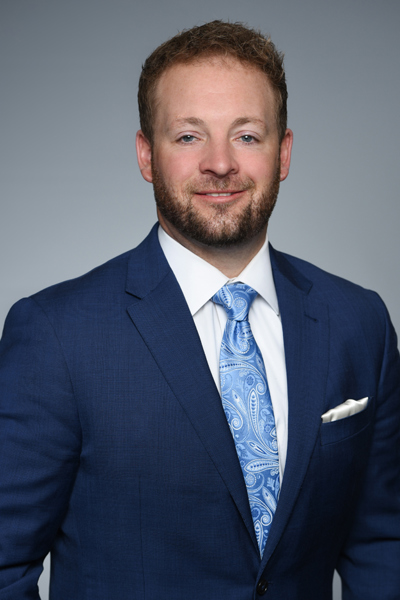
Eric Johnson joined the Senior Housing & Care Finance team at Ziegler in 2019. He specializes in complex structured senior housing transactions, including debt and equity transactions, financial advisory, as well as mergers and acquisitions. Eric has a unique background in finance, market analysis, project management and engineering.
Prior to joining Ziegler, Eric was a senior relationship manager at Bank of the West/BNP Paribas where he was responsible for transaction sourcing, deal execution and for managing relationships with private and institutional healthcare groups across the U.S.
Eric received his Master of Science in real estate finance and construction management from the University of Denver. He also received a Master of Science with an emphasis in structural engineering from the University of Colorado and a Bachelor of Science in civil engineering from Colorado State University.

Patrick Mallen
Senior Vice President
Senior Housing & Care Finance
Senior Vice President

Patrick Mallen joined Ziegler in 2020 as a Vice President in the Senior Housing & Care Finance Practice, progressing to Senior Vice President in 2022. Patrick oversees transaction teams, leading analytical and underwriting efforts to ensure efficient and effective transaction execution.
His expertise lies in capital structure advisory and mergers and acquisitions, with a specialized focus on For-Profit and Not-for-Profit skilled nursing and senior housing providers across the continuum of care. Patrick has successfully completed transactions totaling over $5.5 billion since 2010. His current focus includes sell-side M&A advisory, negotiating debt financings for acquisitions, expansions, and refinancings, as well as raising bond financings for non-traditional Not-for-Profits.
Before joining Ziegler, Patrick served as a Vice President at HJ Sims, a private wealth management, investment banking, and institutional services firm. In this role, he provided capital structure advisory services to senior living and healthcare organizations, with a primary emphasis on new construction, expansion projects, and refinancings.
Prior to HJ Sims, Patrick held the position of Senior Analyst at Public Financial Management (PFM), contributing his analytical expertise to structure and price competitive and negotiated municipal bond transactions for various entities, including municipalities, industrial development authorities, and water and sewer authorities.
Patrick earned a BSBA degree in finance with a concentration in accounting from York College of Pennsylvania. Patrick Holds Series 7, 50, and 79 securities licenses.